Brain Supplement for Pharmacy Shelf: Adding Support
If you work a pharmacy counter, you already know the question that arrives mid-afternoon: “Is there something for focus?” It comes from a student cramming for finals, a parent worried about a teenager, or an adult who simply feels scattered. You want to answer well, and you want to do it without overpromising or sending anyone away empty-handed.
This page is written for the buyer behind that counter. It covers whether a brain supplement for your pharmacy shelf makes sense, what customers will ask, what to check before you recommend anything, and how a partnership with BrainSteady™ starts.
Where Brain Support Supplements Fit on a Pharmacy Shelf
Brain support supplements are products people take to support everyday focus, mood balance, and emotional regulation. They are not treatments, and they are not substitutes for a prescription. A customer who has been prescribed medicine for ADHD, anxiety, or depression should not be nudged toward a capsule or liquid in its place.
That distinction is what makes the category workable for a pharmacy. You sell it as one more everyday wellness option, sitting beside vitamins and sleep products, and you keep the clinical conversations where they belong.
A quick word on the name: our shorthand is “BS, Brain Support, not the other kind.” We’ll use it once and move on.
A simple fit test
Three questions tell you most of what you need to know.
- Customer base. Do people already ask you about focus, stress, sleep, or school performance? If those questions come up weekly, the category has an audience.
- Counseling time. Can your team spend two or three minutes on a medication check at the shelf or counter? If not, this category will frustrate both staff and customers.
- Shelf space. Can you give it a small, clearly labeled spot by age group, rather than scattering products across aisles?
If you answer yes to all three, a small, well-explained range will serve you better than a wall of options, because every extra product is another label your staff has to be able to explain.
This category is not for a pharmacy that wants a hands-off, self-service product. Brain supplements need a conversation, and a shelf with no one ready to have it will not do your customers any favors.
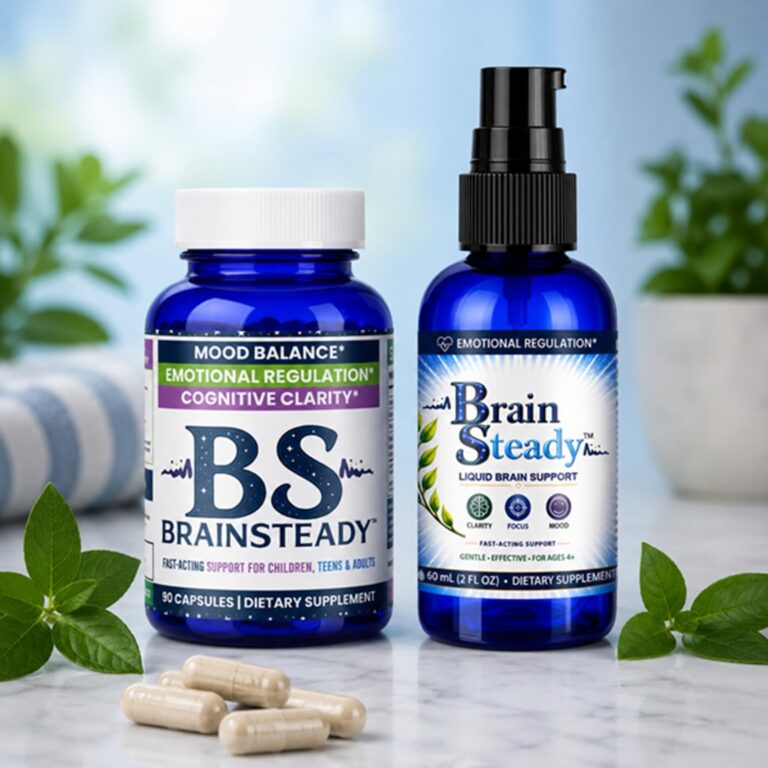
When you are ready to look at a specific range, BrainSteady offers capsule and liquid forms for children, teens, and adults. Our brain formula was developed with focus, mood balance, and emotional regulation in mind, and you can learn more about it on the product pages.
The Questions Pharmacists Hear About Brain Supplements
Customers rarely ask for an ingredient. They ask for relief from a feeling: foggy afternoons, short tempers, a child who can’t settle to homework. Your answers work best when they acknowledge that feeling first and state the evidence level second.
What Adults and Parents Ask Most
“Does it work?” The honest answer is that research on individual ingredients varies in strength, and it does not tell you how a finished product performs for any one person. Say that plainly. Add that sleep, meals, movement, and stress load shape focus and mood too, so a supplement is one piece of a bigger picture.
“Which brand is better?” You do not need to crown a winner. Point to what a customer can compare for themselves: the full ingredient list, the age range on the label, the format, and whether the maker is clear about what it does and does not claim. A checklist for choosing a brain supplement works well as a handout here.
“Is it safe with my daily medicine?” Never answer this from memory at the shelf. Ask what they take, then run the check described in the next section.
“Is it right for my teen or my student?” Start with the label’s age range, because it governs use. Then ask who is requesting it. A teenager who wants to study longer at night may need a conversation about sleep before anything else.
“I read that one vitamin cuts dementia risk by a huge amount.” Headlines like this often come from observational studies, which can show that two things travel together without showing that one caused the other. A single study on a single vitamin also does not tell a reader that buying that vitamin will change their own risk. You can say so kindly: “That’s an interesting finding, and it’s not the same as proof that taking it will protect you.”
“I think I have ADHD” or “I think this is anxiety.” A supplement cannot diagnose anything, and neither can a counter conversation. Acknowledge how hard it is to live with those worries, then point the customer to a physician, psychologist, or other clinician who can assess them properly.
Pharmacist Supplement Counseling: Interaction Points to Cover
Your training is the reason customers trust you with these questions, so it is worth building a short, repeatable routine. The routine below is what separates a pharmacy shelf from a general retail one.
Screening Against the Medication List
Before you recommend any brain supplement, compare the customer’s medicines with the product’s complete ingredient list, not just the front of the box. Take the extra minute even when the customer says it is “just a vitamin.”

Flag these groups every time:
- Customers who take an SSRI or another serotonin-active medicine
- Customers on blood thinners
- Pregnant or nursing customers
- Anyone outside the age range on the label
St. John’s wort and tryptophan-based supplements are the classic teaching examples for SSRI users, because both can add to serotonin activity. The NCCIH overview of St. John’s wort is a reliable reference, and our guide to which supplements interact with SSRI medication goes further than this page can.
Picture a typical case. A customer picks up a brain support product and mentions in passing that they take an SSRI every morning. You read the ingredient list against their medication profile before the sale. If everything is clearly fine, you say so and note it on their record. If anything is unclear, you stop there and send them back to their prescriber with a note about what you checked.
When in doubt, refer. A referral costs the customer a phone call, while a guess can cost much more.
Ingredient Research Versus the Finished Formula
Studies on one ingredient answer a narrow question: what happened when specific people took that ingredient, at a specific dose, in a specific setting. A finished capsule or liquid blends ingredients at its own amounts, so the ingredient’s results do not automatically carry over.
At the counter, you can put it this way: “Research on an ingredient is a reason to be curious, not proof that this product does the same thing.” For a fuller look, see what the evidence says about dopamine and serotonin support.
Keep your evidence statements qualitative. Save “clinically shown” for products that were themselves studied, and be wary of any label that borrows an ingredient study to describe the whole formula. The U.S. Federal Trade Commission expects health claims to rest on competent and reliable scientific evidence that relates to the product actually being sold.
Retail Supplement Education Materials That Support Your Shelf
Good materials do two jobs. They help customers decide without leaning on your staff for every question, and they keep every employee saying the same careful thing.
Shelf Layout and Format Choices
Decide the format mix first. Capsules suit adults and teens who are comfortable swallowing them, while liquids can suit people who prefer not to, including some families with younger children. Our comparison of capsule and liquid formats can help you settle the balance for your own customers.
Then make age labeling impossible to miss. Group products under clear adult, teen, and children’s signs so a parent never has to guess which bottle is meant for which person.
Placement matters as much as signage. Keep brain support products in the wellness area, away from prescription pickup and away from any sign or shelf talker that implies they stand in for a prescription.
Handouts, Counseling Cards, and Staff Scripts
You need only two documents to start.
- A one-page counseling card for customers, covering how to read the label, the disclaimer for your market, the checklist for choosing a brain supplement, and when to see a prescriber.
- A short staff FAQ that explains what our brain formula was developed for, how to read an ingredient list, what staff may and may not say, and when a question goes to the pharmacist.
Short scripts help new staff most. A line like “I can’t say it will treat that, but I can check it against your medicines and show you how to read the label” is easy to remember and keeps everyone inside the lines.
Compliance-Minded Messaging for Brain Support Products
Shelf tags, signs, and handouts are claims too, even when they are only a few words long. Because your name is on them, you want wording you can defend.

Describe our product the way we describe it: our brain formula was developed with focus, mood balance, and emotional regulation in mind. Please do not shorten that to “nutritional formula,” and do not stretch it into something it was not developed to be.
Words to Use and Words to Avoid
Avoid language that says a product will diagnose, treat, cure, or prevent anything. Those words belong to medicines, and BrainSteady does not make those claims.
Also avoid:
- “Clinically shown” when the only studies were on individual ingredients
- “Best” or “#1” rankings that no one can substantiate
- Treatment-style labels such as “anxiety reliever” or “ADHD support”
Use plain, modest wording instead: “developed with focus in mind,” “brain support,” “ask your pharmacist about your medicines.”
In the United States, structure/function claims carry a standard disclaimer: “These statements have not been evaluated by the Food and Drug Administration. This product is not intended to diagnose, treat, cure, or prevent any disease.” The FDA’s dietary supplement pages explain the rules. Name a credible source for any health claim you make, and have a regulatory reviewer confirm your label and shelf wording for your market. This page is not legal advice.
Stocking Family Wellness Supplements Across Age Groups
A family wellness shelf is really a shelf for several different people. One is an adult who wants steadier focus at work or a calmer evening. Another is a caregiver trying to support a teen through exams, or a younger child through a hard school year.
Give the adult customers equal billing. Adults are often the quietest shoppers in this category, and they rarely say “this is for me” until you ask.
Our core message is that behavior is brain-based, and that people do better when they feel better. That framing is kind to everyone, because it moves the conversation away from blame. It does not mean a supplement will change behavior on its own. Routines, sleep, support at school or work, and professional care do much of that work.
The label’s age guidance governs use for children and teens. If a parent asks about a dose or an age not on the label, send them to the product’s directions and their child’s clinician, not to your best guess.
Starting a Pharmacy Supplement Partnership
BrainSteady already serves clinics, practitioners, pharmacies, and wholesale partners, so you would be joining an existing path rather than helping us invent one. It runs on a few conversations, not a long contract negotiation.
From First Contact to First Order
- First contact. Tell us about your pharmacy and where you think the category fits.
- A fit conversation. We talk through your customers, your counseling capacity, and which age groups and formats suit your shelf.
- Wholesale information. Our wholesale team shares terms, including minimum orders and pricing.
- Samples. You discuss sample options with the wholesale team, who set the quantities.
- First order. You decide, on your timeline, whether to stock.
Before you reach out, you can read the pharmacy and clinic partner information to see what we offer partners.
Wholesale Supplement Samples and Questions to Ask First
Whoever your supplier is, ask these before you commit shelf space:
- What labeling and education support do you provide, and is it ready to use?
- Can I get samples so my pharmacists can review the products first?
- What are the reorder terms, and how easy is it to adjust quantities?
- Are the age ranges and ingredient lists clear enough for a medication check?
- Does your marketing stay inside what the evidence supports?
Our wholesale program for pharmacies and clinics goes into more detail on how we handle each of these.
If you’d like to talk through fit, wholesale information, and sample options, contact BrainSteady about partnering, and review the partner information when you’re ready.
Frequently asked questions
Is Prevagen or Neuriva better?
Neither this page nor a pharmacist can honestly name one as better for every customer. Compare the full ingredient lists, the age range, the format, and whether the finished product itself was studied or only its ingredients. Check the customer’s medicines against the ingredients before recommending either.
What vitamin cuts dementia by 40 percent?
No single vitamin has been shown to deliver a result like that for everyone. Headlines of this kind usually come from observational studies, which can show a link without proving a supplement caused the difference. A customer worried about memory should talk with a clinician.
What vitamins are good for boosting brain health in students?
No vitamin is a reliable shortcut to better grades, and research on individual nutrients does not prove a product works for a given student. Sleep, regular meals, and stress load often matter more. If a student wants a supplement, follow the label’s age range and check it against any medicines.
What are the best brain supplements according to Consumer Reports?
Rankings from any outlet reflect that outlet’s own methods, and we don’t call any product the best. A better test is whether the label is clear about ingredients, age range, and claims. The checklist for choosing a brain supplement gives customers criteria they can apply themselves.
Can a pharmacy get samples before stocking BrainSteady?
Sample options are part of the partnership conversation. Our wholesale team sets sample quantities and shares minimum orders and pricing. Contact us to start that conversation.