
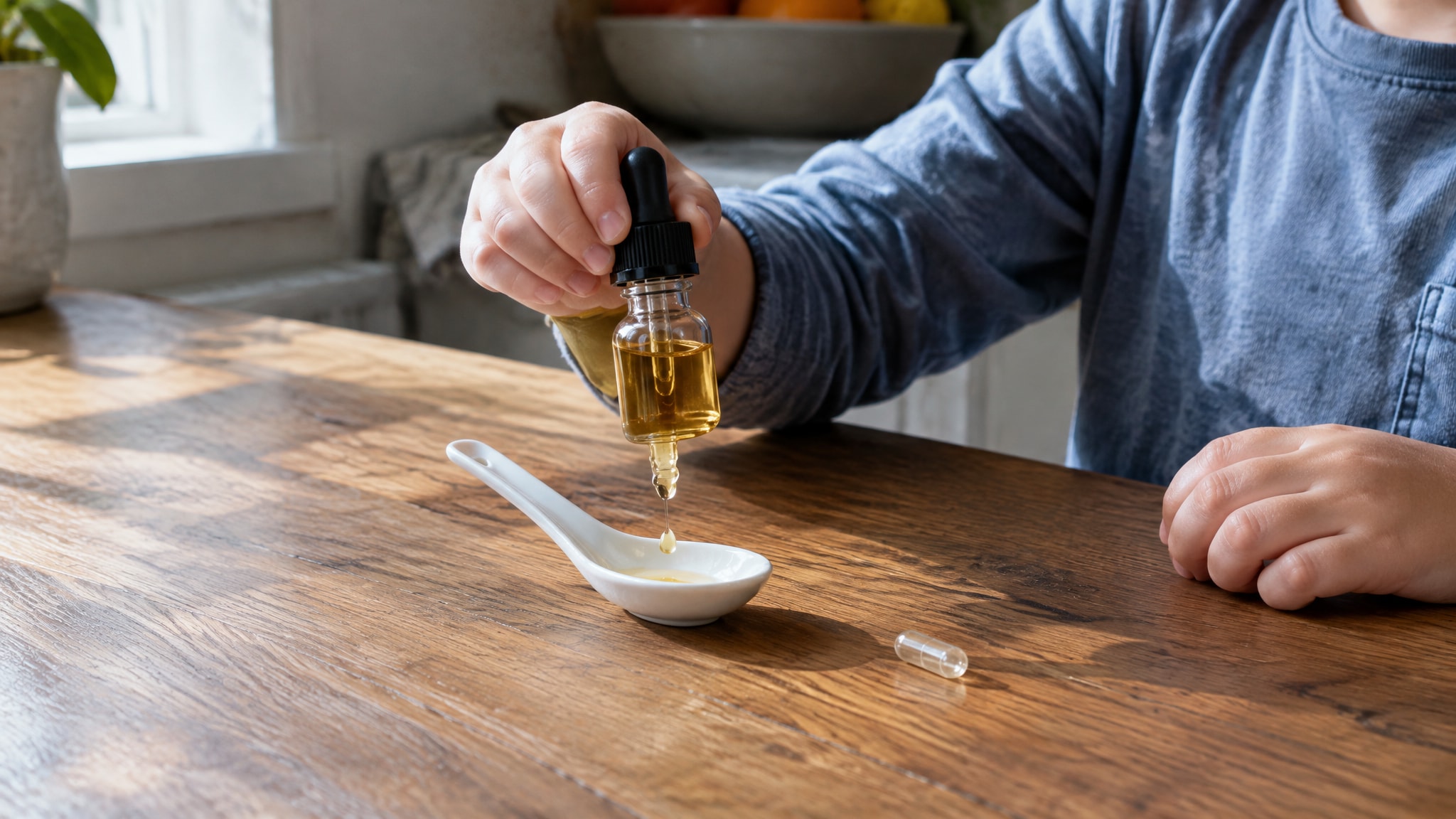
Liquid Brain Supplement for Kids: How to Choose & Use
If your child gags on a capsule, clamps their mouth shut, or chews it and grimaces, you’re in very good company. Swallowing pills is a learned skill, and some people take much longer to learn it than others.
This guide is about the practical side of liquid formats: how to choose one, how to make it easier to accept, and what to ask a clinician first. It doesn’t promise results. It’s meant to help you make steady, informed choices.
Supplements for Kids Who Have Trouble Swallowing Pills
A daily standoff over a capsule wears everyone down, and it says nothing about your parenting or your child’s willingness. Some kids dislike the texture, some fear choking, and some simply find a capsule too big for their throat.
Adults run into the same wall. Plenty of grown-ups have never gotten comfortable with pills, and they often skip supplements for that reason alone.
A liquid can take the swallowing hurdle out of the routine, though it brings its own questions about taste, measuring, and storage, which the sections below work through one at a time.
Liquid vs. Capsule Supplements for Kids
“Liquid” covers more than one product type. It includes drops, syrups, single-dose shots, and oils, and each one pours, tastes, and stores a little differently. Gummies are another common form, but they are chewed rather than swallowed whole or poured, so they’re a separate category.
Capsules have real advantages. They’re compact, they hide taste completely, and the dose is already measured. A liquid trades that convenience for easier swallowing, so you take on a bit more work in return.
What a Liquid Format Changes, and What It Doesn’t
The trade-offs are fairly predictable, and it helps to weigh them before you buy rather than after the bottle is open.
- Swallowing: A liquid is usually far easier for a child who can’t manage capsules or tablets.
- Measuring accuracy: You have to fill a dropper or cup to the right line each time, and small slips add up over weeks.
- Taste: Capsules hide flavor. A liquid puts it on the tongue, so some kids will notice it right away.
- Storage after opening: Many liquids have specific instructions once the seal is broken, such as where to keep the bottle and how long to use it. The label is your guide.
What a liquid doesn’t change is the supplement itself. Format alone doesn’t make a product more effective, and a liquid isn’t “stronger” or “better” than a capsule. It’s simply easier to take for some people, and a supplement that gets taken as directed is more useful than one that stays in the cupboard.
How to Choose a Liquid Brain Supplement for Your Child
Start with what the bottle tells you, then look at what the research can and can’t say. If you’re shopping for a liquid brain supplement for kids, the label is where most good decisions are made.
Reading the Label Before You Buy
Run through these checks in order, and keep going even if the first few look fine.
- Age guidance. Make sure the product is intended for your child’s age. A formula made for adults or teens isn’t automatically right for a younger child.
- Serving size and dosing tool. Look at how much counts as one serving and what measures it, such as a dropper or a marked cup. Use only that tool.
- Full ingredient and allergen list. Read every line, including flavorings and anything the product is made without or alongside. If your child has an allergy, this step matters most.
- Storage instructions. Note whether it needs refrigeration after opening, and keep the bottle out of reach of children, since a flavored liquid can look like a treat.
- Third-party testing. If the label or brand states that a product was independently tested, check what was tested and by whom. If it says nothing, that’s useful to know too.
If you’d like to see what’s in our brain formula before comparing it with anything else, the ingredient details for our brain formula are laid out in one place.
Ingredient Research Versus Finished-Product Evidence
These are two different kinds of evidence, and they’re easy to blur together.
Research on a single ingredient looks at that nutrient on its own, often at specific amounts and in specific groups of people. For attention in children, studies of single nutrients are often mixed or limited. The NIH Office of Dietary Supplements notes, for example, that the omega-3 research on attention-related outcomes hasn’t been consistent.
A finished product is a different thing again, because the ingredients, amounts, and form all work together. Evidence about one ingredient doesn’t automatically carry over to a blend.
That’s why no single nutrient is the “best brain supplement” for every child. Needs differ, and so do diets, sleep, and health histories.
Our brain formula was developed with focus, mood balance, and emotional regulation in mind. That describes the intent behind it, not a guaranteed outcome, and BrainSteady doesn’t diagnose, treat, cure, or prevent any condition. The FDA’s dietary supplement page explains the same limit for supplements generally.
How to Give Kids Liquid Supplements: Taste, Mixing, and Consistency
This is where most families succeed or struggle. A few small habits make the difference, and none of them need special equipment.
Making Taste and Texture Easier to Accept
Let your child have a say. A small taste on its own, before it goes into anything, tells you whether the flavor is the problem or just the surprise. Some children will then pick a familiar food or drink to mix it into, and that sense of choice often counts for as much as the flavor itself.
Texture matters as much as taste. A thin liquid disappears into a drink, while a thicker one may cling to a cup, and any grit or separation can put off a child who’s sensitive to mouthfeel. Stir well, and check whether the mix stays evenly blended or settles at the bottom, because a dose left behind in the glass isn’t a dose taken.
Check the label before you pick the food or drink. Some products have instructions about what they can be mixed with, and those instructions beat any general tip you read online, including this one.
Mixing and Measuring for the Full Dose
Mix the dose into a small amount, a spoonful of yogurt or a few sips of juice, rather than a full glass. Children rarely finish a large drink, and whatever is left in the glass is part of the dose that wasn’t taken.
Measure with the dosing tool that came with the product. Kitchen spoons vary a lot in size, so they can’t be trusted for an exact dose.
Then keep it boringly predictable. Give the dose at the same time each day, in the same way, so it becomes part of the day rather than a negotiation.
Picky Eaters and Supplement Routines
Picky eaters and supplements can be a rough pairing, because the kids most sensitive to flavor are often the ones you most want to find a gentle routine for. Expect some refusals. A skipped day or a wrinkled nose is normal, and it doesn’t mean the approach has failed.
Building a Routine That Sticks
Attach the dose to something that already happens, like breakfast, brushing teeth, or a step in the bedtime wind-down. A habit you already have is much easier to build on than a new item on the day’s list.
Picture a caregiver whose child finds capsules hard to swallow. They switch to a measured liquid at breakfast, stirred into a familiar drink, and the daily standoff becomes a shorter, more predictable step. It won’t go smoothly every morning, but it has a shape.
Now picture an adult who has always disliked swallowing pills and is picky about flavors. They try a liquid for their own focus and find that the measuring and the daily timing take more practice than they expected. They start by taking it right after the morning coffee, with the dosing tool left next to the mug, and it stops being something they have to remember.
Grown-ups need routines as much as kids do, and the same ideas apply. If you’re supporting an older child, our parent guide to brain supplements for teens goes deeper on focus and mood at that stage.
Questions to Ask a Clinician Before You Start
Pediatricians and pharmacists commonly advise checking any supplement against a child’s current medicines, allergies, and age before starting, and confirming exactly how each dose is measured. A pharmacist is often the quickest person to ask, and the conversation usually takes only a few minutes.
Health History, Medicines, and Allergies
Bring this short list to the appointment or the pharmacy counter:
- Every medicine your child takes now, including over-the-counter ones
- Any other supplements or vitamins, even gummies
- Known allergies and sensitivities, plus the full ingredient list from the label
- Your child’s age and weight, so the clinician can compare them with the label’s guidance
- The product label or a photo of it, including the dosing tool
Dosing, Side Effects, and When to Call a Clinician
Ask how the clinician wants each dose measured, whether timing matters with meals or other medicines, and how long it makes sense to try something before reviewing it together. Then ask which changes to watch for, such as stomach upset, a rash, or shifts in sleep or appetite.
If your child has trouble breathing, swelling, hives, or any reaction that worries you, stop the product and get medical help straight away. For milder changes, call the clinician and describe what you’ve seen.
A supplement does not diagnose or treat attention, mood, or behavior concerns, and it isn’t a substitute for an assessment. If you’re worried about how your child focuses, feels, or behaves, a clinician is the right person to look into it. That applies to adults, too.
Realistic Expectations for a Calm and Focus Routine
A supplement is one part of a bigger picture. Clinicians generally treat sleep, nutrition, daily routines, and school or family support as the foundation that any supplement sits on top of, not a replacement for them. A child who’s tired, hungry, or overwhelmed at school will struggle with focus and mood whatever is in the bottle.
That’s the thinking behind “We do better when we feel better.” It’s a way of looking at things, not proof that a product works, and it’s a reminder to look at the whole day. Behavior is brain-based, which is a kinder starting point than asking why a child “won’t” do something.
Change, if it comes, takes time and looks different from child to child. A liquid supplement for children’s focus shouldn’t be expected to transform a week, and some kids may notice nothing at all. If you’re looking for a quick fix for a hard stretch, this isn’t it.
Caregiver Tips for Consistency and Honest Tracking
Day-to-day judgments are unreliable, because one bad afternoon can color a whole week. Tracking over weeks gives a truer picture.
- Keep a simple note each day: when the dose was given, sleep, mood, and anything unusual.
- Change one thing at a time, so you can tell what’s making a difference.
- Review the notes together once a week or two, and take them to the clinician.
- Include your own observations too. Adults taking a supplement benefit from the same honest record.
Sometimes the notes will show that the routine is helping very little, and that’s useful information, too. (And yes, in our shorthand, BS means Brain Support, not the other kind.)
When you’re ready to compare, you can browse the liquid and capsule options in the BrainSteady shop and read the ingredients carefully before deciding. Take your time, and bring your questions to your clinician first.
Frequently asked questions
What vitamins can help kids focus in school?
No single vitamin has been shown to improve focus for every child, and research on individual nutrients and attention is often mixed or limited. If a child is low in something, such as iron, a clinician can check and advise. Sleep, regular meals, and school support do a lot of the work, so look at those first.
Which vitamin is best for the brain?
There isn’t one best vitamin or nutrient for every child or adult. Needs depend on diet, age, health history, and medicines. A pediatrician or pharmacist can help you work out what, if anything, makes sense for your child.
How can I increase my child’s brain power?
The basics matter most: consistent sleep, regular meals, predictable routines, movement, and support at school and home. A supplement can sit on top of those, but it can’t replace them. If you’re worried about learning or attention, ask a clinician or the school for an assessment.
Can I mix a liquid supplement into a hot drink or a full glass of juice?
Follow the label first, because some products have instructions about what they can be mixed with. As a general rule, use a small amount of food or drink your child will finish, so the whole dose is taken. If the label doesn’t say, ask a pharmacist before using heat.




One Comment