

Best Supplements for Emotional Regulation in Adults: Honest Look
You snap at someone you love over a dishwasher. Your mind races at 2 a.m. Or the whole day feels flat, like someone turned the color down. If you’ve searched for supplements for emotional regulation, you’ve probably met a lot of confident lists. This article takes a slower, more honest route through what the research on common ingredients can and can’t tell you.
Irritability and Overwhelm: What They Can Feel Like for Adults
Emotional regulation is the everyday ability to notice a feeling, ride it out, and respond the way you’d like to. Irritability is what it looks like when that gets harder: a short fuse after a long day, a sharp tone you didn’t plan, a to-do list that suddenly feels like a wall.
For adults it rarely looks dramatic. It might be racing thoughts at the end of a workday, feeling swamped by small decisions, or going numb when you expected to feel something.
None of that is a character flaw. We do better when we feel better, and a lot of things shape how we feel: sleep, workload, health, hormones, caregiving, and plain exhaustion.
Here is the part most product pages skip. Direct research on irritability in healthy adults is thin, and no ingredient discussed below is a fix for irritability, anxiety or low mood.
We’ll call this “BS” once, and only to be clear: here it means Brain Support, not the other kind. The aim is to help you sort real information from hype, so you can decide what, if anything, is worth a conversation with your clinician.
Emotional Regulation Is Brain-Based, Not a Willpower Test
Behavior is brain-based. Your brain is an organ, and it responds to how much you slept, what and when you ate, whether you moved today, how much stress you’re carrying, and whether anyone is helping you carry it.
That’s why “just try harder” misses the point. When your brain is running on four hours of sleep and a skipped lunch, calm is simply harder to reach, and that says nothing about your character.
It also explains why no single capsule can be a reliable fix. If mood depends on many inputs at once, one ingredient can only nudge one small part of the picture, and only for some people.
What “Mood Balance” Can and Can’t Mean
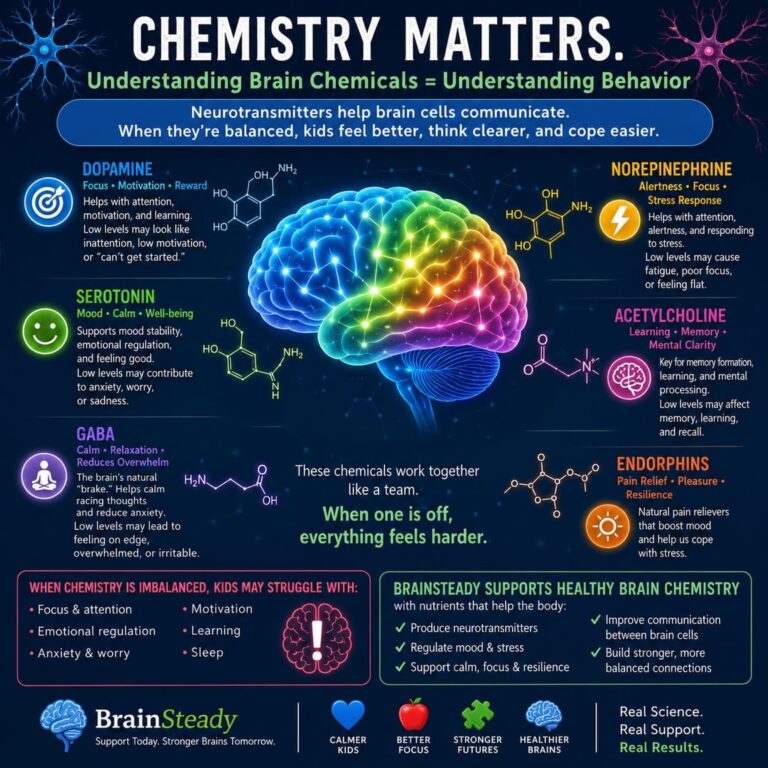
“Mood balance” often rides on an old shortcut: the idea that low mood or irritability means a chemical imbalance, and that the right ingredient will rebalance it. That idea is far too simple.
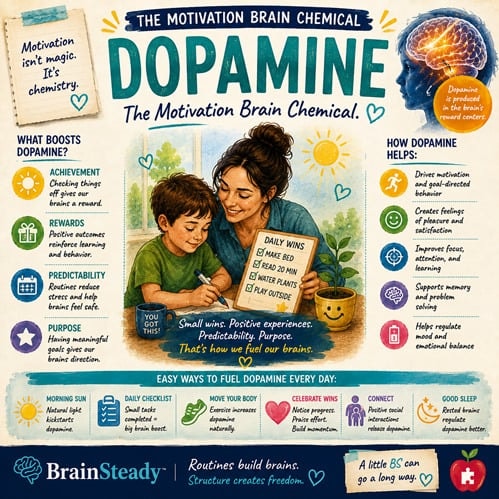
The body regulates dopamine and serotonin tightly, across many systems. Taking a precursor ingredient doesn’t predictably raise or “balance” either one, and human evidence that it changes everyday mood in healthy adults is limited.
So when we say mood balance, we mean a goal and a direction, not a mechanism we can promise. Our brain formula was developed with focus, mood balance, and emotional regulation in mind. That describes design intent, and it doesn’t describe a guaranteed result for any one person.
How to Read the Evidence on Supplements for Emotional Regulation
Lists of the best supplements for emotional regulation in adults tend to flatten very different evidence into one ranking. A more useful approach is to sort ingredients into four levels:
- Well supported for a documented need. Good trials show benefit in people who actually need the nutrient, such as correcting a confirmed deficiency.
- Promising but limited. Some trials point the same way, but they’re small, short or inconsistent in design.
- Mixed or thin. Results conflict, or effects shrink in healthy people.
- Little human evidence. The idea rests mostly on lab or animal work.
None of the ingredients below reaches the first level for everyday emotional regulation in healthy adults. B vitamins come closest, but only when someone has a documented deficiency.
That’s the honest baseline, and it applies whether a product is a single ingredient or a blend.
Ingredient Studies Are Not Product Studies
A study on magnesium tells you about magnesium at a certain dose, in a certain form, in a certain group of people. It doesn’t tell you that a finished product containing some magnesium will do the same thing for you, because the dose, form and mix may all differ.
The same goes for us. Our brain formula was developed with focus, mood balance, and emotional regulation in mind, and we’re glad to explain what’s in it. We don’t claim it treats, cures, prevents or diagnoses anxiety, depression or irritability, and ingredient research is not evidence about the finished product.
A few label checks help with any supplement you’re weighing:
- Studied dose versus labeled amount. Compare what the trials used with what’s actually in a serving.
- Elemental versus compound magnesium. A label may list 500 mg of magnesium citrate, but the elemental magnesium inside is much lower. Look for the elemental figure.
- EPA and DHA amounts. “1,000 mg fish oil” says little. The EPA and DHA content is what counts.
- Third-party testing. Independent testing for purity and content is a reasonable thing to look for.
Magnesium and L-Theanine: Promising, Modest, and Still Being Studied
Both of these sit in the “promising but limited” group. That means they’re worth understanding, and it doesn’t mean they’re proven for you.
Magnesium for Emotional Regulation
Magnesium takes part in hundreds of processes in the body, including nerve signaling. Small trials suggest it may help with subjective stress and anxiety. A 2017 systematic review in Nutrients by Boyle, Lawton and Dye concluded that magnesium may help, while noting that the trials were too few and too varied for firm conclusions.
So keep expectations modest. Evidence about stress and anxiety isn’t the same as evidence about irritability, and it isn’t the same as evidence in people who already get enough magnesium.
Food is a sensible first stop. Leafy greens, nuts, seeds, legumes and whole grains all supply magnesium, and you can build them into meals without buying anything.
You’ll see glycinate and citrate marketed for calm. We haven’t seen solid head-to-head mood data comparing magnesium forms, so treat those claims as marketing until trials say otherwise.
One more practical point: a standard blood test reflects total body magnesium poorly, because most of it is stored in bone and tissue. A “normal” result doesn’t rule out low intake, and a clinician can help you interpret it.
L-Theanine for Calm
L-theanine is an amino acid found in tea. Small, short trials report modest gains in self-rated relaxation and in some attention tasks, and many of those studies paired it with caffeine.
That pairing matters. If you take L-theanine on its own, you can’t assume you’ll get the same effect the trials saw.
It isn’t a sedative, and it isn’t a quick way to switch off a bad mood. Long-term data are limited, so nobody can say with confidence what months or years of daily use look like.
Omega-3s and B Vitamins: Where the Evidence Helps and Where It Stops
These two have bigger research bases than the ingredients above, which makes the mixed results more informative, not less.
Omega-3 for Mood
Omega-3s from fish oil come as EPA and DHA. Trials in people with depressive symptoms are inconsistent, though some show a signal for EPA-heavy formulas used as an add-on to other care. In healthy adults, effects on mood look small.
That’s why we’d call omega-3 for mood a mixed-evidence ingredient, and why we wouldn’t call any omega-3 a mood fix.
Fatty fish such as salmon, sardines and mackerel remain the food-first source. If fish isn’t part of your diet, that’s a reason to talk with a clinician or pharmacist about options, and not a reason to grab the highest-dose bottle.
B Vitamins: Deficiency Changes the Picture
B6, folate and B12 support pathways that help the body build neurotransmitters and keep nerves working. The strongest-supported use is simple: correcting a documented deficiency, where fixing the gap can improve how people feel and function.
For adults with adequate intake, results from B-complex supplements are mixed. If your levels are already fine, extra B vitamins aren’t likely to add much to your mood.
Testing beats guessing here. High-dose folic acid can mask low B12, which can delay the discovery of a deficiency that matters. A blood test is a quick way to find out where you stand before you add anything.
Safety and Interactions to Check Before You Start
“Natural” feels safe, but ingredients act on the body, and a few have firm limits. You can work through most of this in ten minutes with a pharmacist.
Who Should Check With a Clinician First
We can’t know your health history, so this list is deliberately broad. Check first if you:
- take prescription medicines, such as antidepressants, blood thinners or blood pressure drugs
- are pregnant or breastfeeding
- have a kidney or liver condition
- have a fish or shellfish allergy, which matters for some omega-3 products
If your low mood is persistent, or you’re having thoughts of self-harm, please seek professional or crisis support promptly. A supplement trial is not the right response. In the US you can call or text 988, and elsewhere your local emergency number or crisis line can help.
“Natural” Doesn’t Mean Free of Interactions
Some specifics worth knowing:
- Magnesium. The NIH Office of Dietary Supplements sets 350 mg per day as the adult upper limit for magnesium from supplements. Food magnesium doesn’t count toward it. Diarrhea and cramping are common above that level, and magnesium can reduce absorption of certain antibiotics.
- Vitamin B6. The NIH sets 100 mg per day as the adult upper limit from supplements, and warns that long-term high intake can damage nerves.
- Omega-3s. High doses may add to bleeding risk if you take anticoagulants.
- 5-HTP and St. John’s wort. Both can add to serotonin activity alongside antidepressants.
- L-theanine. It may modestly lower blood pressure, which matters if you already take medicine for it.
- Ashwagandha. Some products have been linked to liver injury.
Multiple products can contain the same nutrient, so add up your totals. A multivitamin, a B-complex and a “calm” blend can quietly stack B6 well past the limit.
Pairing Supplements With Daily Routines and Your Care Team
If you decide to try something, change one thing at a time. Otherwise you won’t know what helped, or what caused a stomachache.
Pair it with the basics: steady sleep, regular meals and some movement. Those do more for most people than any capsule, and they give an ingredient the best chance of showing whether it matters for you.
Keep a simple log for several weeks. Note your mood, your sleep and the time you take anything. A pattern is much easier to spot on paper than in memory.
Questions to Bring to Your Healthcare Provider
Take this to a clinician or pharmacist, especially if irritability has lasted weeks and not days. A typical case: an adult who has been short-tempered for weeks during poor sleep and heavy workloads brings a sleep log, a list of current supplements and medicines, and a question about whether a basic blood test such as B12 makes sense, all before adding anything new.
Bring:
- every supplement you take, with dose and form
- your current prescriptions
- how long the mood or irritability changes have lasted
- a question about whether a test, such as B12, makes sense
That one visit can save you months of trial and error.
When you’re ready, you can explore ingredient-level details on our Ingredients page, or send us your questions. If you’re also supporting a young person, our parent guide to brain supplements for teens may be useful.
Frequently asked questions
Is there a supplement that reliably fixes irritability in adults?
No. Direct research on irritability in healthy adults is thin, and none of the ingredients discussed here is proven to fix it. Sleep, stress, food, movement and health conditions all play a part, so a single ingredient can only be one small piece.
Can I take magnesium and L-theanine together?
Many people do, and the two aren’t known for a specific interaction. But L-theanine may modestly lower blood pressure, and magnesium can reduce absorption of certain antibiotics. Check with a pharmacist if you take prescription medicines.
Should I get a B12 test before taking B vitamins?
Testing is the better route. B vitamins have the strongest support when they correct a documented deficiency, and high-dose folic acid can mask low B12. A clinician can tell you whether a test makes sense for you.
Does the research on these ingredients prove that a BrainSteady product works?
No. Ingredient studies use specific doses, forms and groups of people, and they don’t test a finished product. Our brain formula was developed with focus, mood balance, and emotional regulation in mind, but that describes design intent, not a guaranteed result.
When should I talk to a healthcare provider instead of trying a supplement?
Talk to one first if you take prescription medicines, are pregnant or breastfeeding, or have kidney or liver conditions. Also go if low mood or irritability has lasted for weeks. If you have thoughts of self-harm, seek crisis support right away.



5 Comments