
Dopamine & Serotonin Support Supplements: What Evidence Says
If you’ve searched for ways to “boost” dopamine or serotonin, you’ve probably noticed that the answers sound much more certain than the science is. That’s frustrating when you’re tired, scattered or low and want something that works. Wanting a clear answer is reasonable. This article gives you the accurate version: how these two messengers are made, which nutrients help, what human research has and hasn’t shown, and what to check before you buy anything.
Amino acids and neurotransmitters: how dopamine and serotonin are made
A quick note on language first. We’ll use “BS” once or twice here, and it means Brain Support, not the other kind.
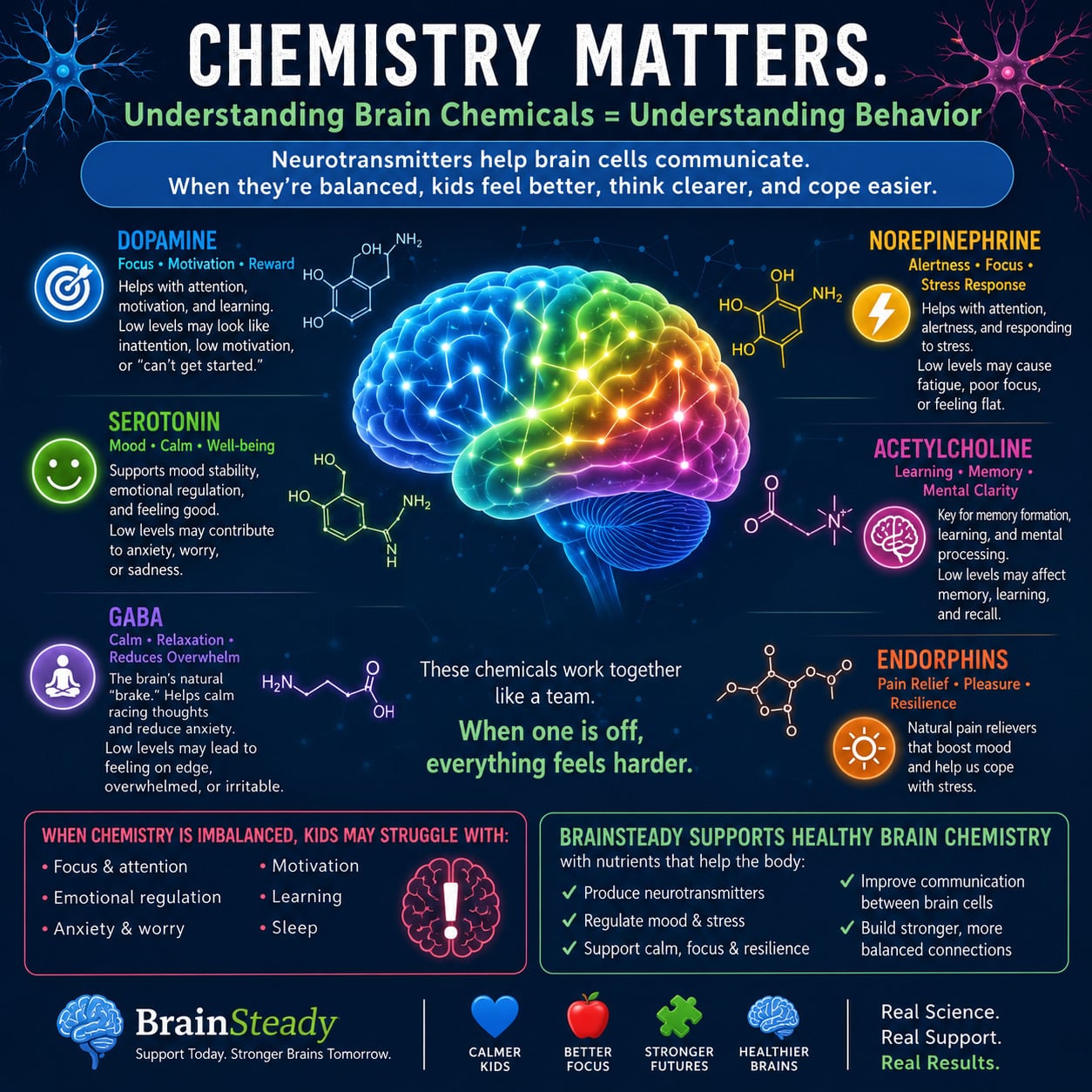
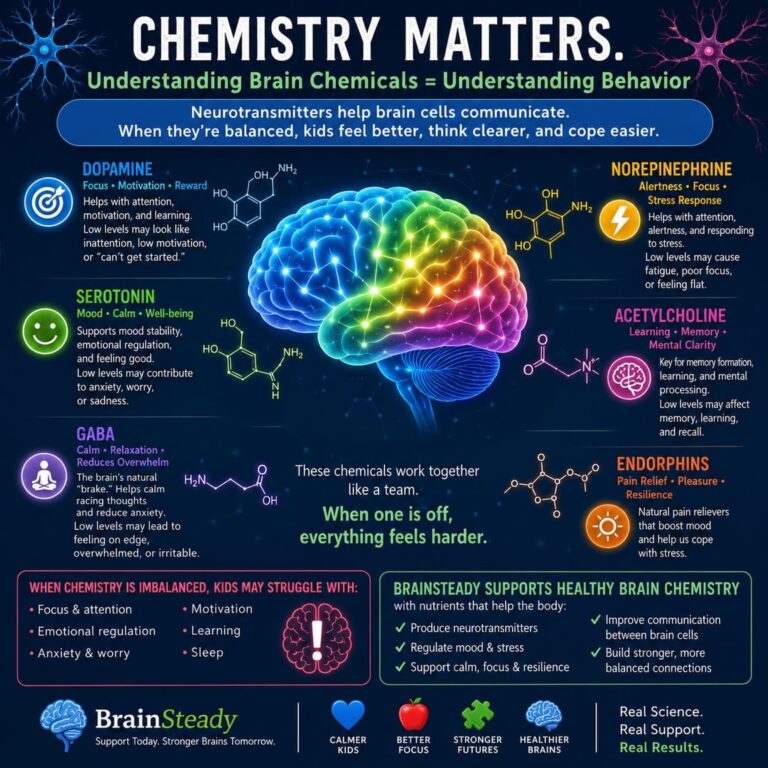
Dopamine and serotonin are chemical messengers. Your body builds them from amino acids that come from protein in food. Dopamine starts with tyrosine (which the body can also make from phenylalanine). Serotonin starts with tryptophan.
Each pathway runs in steps, and each step needs a specific enzyme. Tyrosine becomes L-DOPA, and L-DOPA becomes dopamine. Tryptophan becomes 5-HTP, and 5-HTP becomes serotonin. The first step in each chain is tightly controlled, which is why swallowing a precursor doesn’t simply fill a tank.
Several other things stand in the way. Amino acids compete to cross into the brain, so a dose of one doesn’t guarantee more arrives. The body also breaks neurotransmitters down and recycles them continuously. And most of the body’s serotonin sits in the gut, not the brain.
That is why supplements affect neurotransmitters only indirectly, if at all. A capsule can supply a building block or a helper nutrient, but your body decides what to do with it. Having a precursor on a label tells you what the ingredient is, not that brain levels rise.
Nutrients as cofactors: where B vitamins, folate and magnesium fit
Think of the amino acids as raw material and the enzymes as the workers. Cofactors are the tools those workers need. Without them the line slows down, but handing out extra tools to a fully equipped crew doesn’t speed anything up.
B vitamins and mood: a cofactor role, not a mood switch
Vitamin B6, in its active form, is a required helper for the last step in both pathways. That’s the conversion of L-DOPA to dopamine and of 5-HTP to serotonin. A helper is not the same as a booster, and that distinction is what this whole article rests on.
The clearest mood concerns linked to B vitamins come from deficiency. If your diet or health leaves you short, correcting that makes sense, and a clinician can check it with you. If you already get enough, there’s no good evidence that more B6 pushes dopamine or serotonin higher.
More isn’t harmless, either. Very high long-term B6 intake can damage nerves, causing numbness and tingling. The NIH Office of Dietary Supplements B6 fact sheet sets out the upper intake level for adults.
Magnesium and folate: enzyme helpers with real limits
Magnesium takes part in hundreds of enzyme reactions throughout the body, and folate supports broad metabolic work that touches the same neighbourhood as these pathways. Neither is a dopamine or serotonin ingredient in the way tyrosine or tryptophan is. They are general helpers.
Low levels of either can matter for how you feel, which is a good reason to look at your diet and ask about testing if you suspect a gap. What hasn’t been shown is that adding more to adequate levels clearly shifts dopamine or serotonin. If you eat reasonably well, extra magnesium or folate is unlikely to work as a mood lever.
Neurotransmitter support ingredients: what the human evidence covers
Most human studies of these ingredients are small, short and test one ingredient at one dose. That tells you how the ingredient behaved under study conditions, which is useful, but it isn’t a forecast for your Tuesday afternoon. The strongest sources are systematic reviews that pool several trials and say how reliable they are.
Tyrosine and dopamine: where the trials look most encouraging
Tyrosine is the raw material for dopamine, so it’s the most logical precursor to test. Some studies found benefits for memory or thinking under demanding conditions, such as acute stress, cold or lost sleep. Results in rested, healthy people are far less convincing.
That pattern fits what you’d expect. When the body is under strain, the supply of building blocks may matter more. When it isn’t, the regulated pathway doesn’t need the extra.
Tyrosine isn’t for everyone. It hasn’t been shown to treat low motivation or attention difficulties, and it may interact with thyroid medicines and some others, so it’s a conversation for your prescriber if you take any.
Tryptophan and 5-HTP: serotonin precursors with mixed results
Tryptophan is the starting amino acid for serotonin, and 5-HTP is one step further along. Trials on mood and sleep are small and mixed, with varied doses and short durations. The human data for 5-HTP is thinner still, and it carries more interaction warnings.
Manufacturing matters too. In the late 1980s, L-tryptophan was pulled from US shelves after a contaminated batch from one manufacturer was linked to a serious illness outbreak. It later returned to the market. The episode shows that a precursor’s safety depends on how it’s made as well as what it does.
L-theanine and magnesium: neighbours, not building blocks
L-theanine, an amino acid found in tea, has small trials on relaxation and attention. It is not a direct dopamine or serotonin building block, even when it appears in a dopamine blend. Magnesium has small trials on stress and low mood, and the reviews generally describe the evidence quality as limited.

No single supplement has been shown to be the strongest way to raise dopamine or serotonin. Anyone who names one is going beyond the research.
Myths about boosting dopamine and serotonin
“A precursor works like a switch.” If it did, one dose of tyrosine would make you focused at your desk. The body regulates these pathways, so more raw material doesn’t mean more messenger.
“More dopamine is always better.” It isn’t. Dopamine works within a range, and too much activity is linked to restlessness, poor sleep and anxiety. Medicines that raise it are prescribed carefully for that reason.
“A longer ingredient list means a stronger effect.” Ten ingredients at tiny doses can do less than one at a studied dose. Length tells you about the label, not the outcome.
“Natural means proven or safe.” St. John’s wort is a plant, and it interacts with many medicines. The tryptophan episode above started with a natural amino acid.
“Low serotonin causes low mood.” This idea is contested. A widely discussed 2022 review found no consistent evidence that depression is caused by low serotonin levels, though researchers still debate what serotonin does in mood. Feeling low, flat or unmotivated is not a self-test for a neurotransmitter shortage. Sleep, stress, illness, grief and many other things can cause the same feelings.
If you’re looking for the broader picture after this, we wrote an honest look at supplements for emotional regulation in adults with the same limits-first approach.
Safety and medication interactions to check first
Because these ingredients sit close to the pathways that many prescription medicines act on, the safety question comes before the benefit question. If you take any regular medicine, check with a pharmacist or prescriber before adding a precursor.
Clinicians who want a professional view can read our clinician’s guide to supplements for focus and mood.
Medicines that already act on serotonin or dopamine
Prescribing information for SSRIs, SNRIs and MAO inhibitors warns about serotonin-related interactions. Clinical references advise against combining 5-HTP or L-tryptophan with them unless a prescriber guides it. The concern is serotonin syndrome, a potentially serious reaction you can read about on Wikipedia’s serotonin syndrome page.
Other combinations to know about:
- SAMe or St. John’s wort alongside antidepressants
- High-dose B6 alongside levodopa, which can interfere with how it works
- Stimulants and other dopamine-acting medicines, which deserve a prescriber conversation before you add a precursor
Talk to a clinician first if you’re pregnant or breastfeeding, if the person is a child or teen, or if you have an existing mood or neurological condition. Caregivers weighing any product for a teenager may find our parent guide to teen focus and mood useful alongside that conversation.
Supplements for dopamine and serotonin support: finished blends versus single ingredients
A tyrosine trial tests tyrosine. A finished product combines several ingredients at its own doses, and that’s a different thing to test.
Why single-ingredient studies don’t automatically transfer to a blend
Single-ingredient trials use set doses, specific forms and defined groups of people, so their results describe that ingredient in that setting. A blend may contain less of each ingredient than the trials used, or combine ingredients that were never studied together.
So a “dopamine support supplement” or “serotonin support supplement” claim needs evidence about the product itself. Without it, the claim is a hope built on ingredient research, however confident the label sounds.
Reading a label, and where our brain formula fits
Before you trust any product in this category, work through these checks. Our seven-point checklist for choosing a brain supplement goes into more detail.
- Dose per serving. Compare it with the doses used in studies, not just whether the ingredient appears.
- Ingredient forms. The form listed (for example, active B6 versus a different form) tells you what you’re actually getting.
- Proprietary blends. If a blend hides individual amounts, you can’t judge any of it.
- Third-party testing. Independent testing speaks to purity and contents, which the tryptophan story shows is no small matter.
- Wording. Wellness language is one thing. Claims to treat or cure a condition are another, and they’re a red flag.
Our brain formula was developed with focus, mood balance and emotional regulation in mind. That describes a design goal, not a clinical outcome, and it isn’t a claim that it diagnoses, treats, cures or prevents anything, or that it changes dopamine or serotonin levels. If you’d like to compare what’s listed with the evidence above, you’re welcome to look at our ingredients page.
Everyday habits that support dopamine and serotonin balance, and when to ask for help
Habits aren’t glamorous, but they have the most dependable link to mood and focus. None of them is a way to “balance dopamine and serotonin naturally” in a measurable sense, because nobody can see those levels from the outside. They’re simply what the research points to most consistently.
- Sleep. The evidence is strong. Poor sleep worsens mood, attention and stress tolerance, whether you’re a night-shift nurse or a parent up with a newborn.
- Movement. Regular physical activity has solid evidence for mood, even in modest amounts.
- Daylight. Morning light helps regulate your body clock, and the link to mood is reasonably well supported.
- Protein with meals. Eating enough protein supplies the amino acids your body uses. The evidence is indirect, but the logic is sound.
- Stress routines. Breathing exercises, walks or a few quiet minutes help many people, though results vary and the research is mixed.
Pick one that fits your week, not all five. If you want a place to start, our adult focus and calm guide covers everyday steps without assuming your age or situation.
These habits are not a substitute for care. If low mood, anxiety or low motivation lasts more than a couple of weeks, or gets in the way of work, relationships or caring for others, talk to a doctor or mental health professional. If you ever feel unsafe or think about harming yourself, contact your local emergency or crisis service right away, such as 988 in the US or Samaritans on 116 123 in the UK and Ireland.
Frequently asked questions
What supplement increases serotonin the most?
No supplement has been shown to be the strongest way to raise serotonin. Tryptophan and 5-HTP are the direct precursors, but human trials are small and mixed, and a precursor doesn’t prove brain levels rise. They can also interact with antidepressants, so talk to a prescriber first.
How can I naturally increase dopamine?
There’s no reliable way to measure or deliberately raise your dopamine at home. Sleep, regular movement, daylight and enough protein have the most dependable links to mood and focus. Treat them as supportive habits, not a dopamine fix.
What are the signs of low serotonin?
There is no checklist that confirms low serotonin. Low mood, poor sleep, irritability and anxiety have many causes, and the link between serotonin and depression is debated by researchers. If these feelings last more than a couple of weeks, a clinician can look at the whole picture.
What is the best supplement for increasing dopamine levels?
None has been proven best. Tyrosine has the most encouraging trials, mainly for thinking under stress or sleep loss, but results in rested people are weaker. If you take stimulants, thyroid medicines or other prescriptions, ask a prescriber before trying it.

3 Comments